Dual Zone Water Timer: How Independent Outlets Work
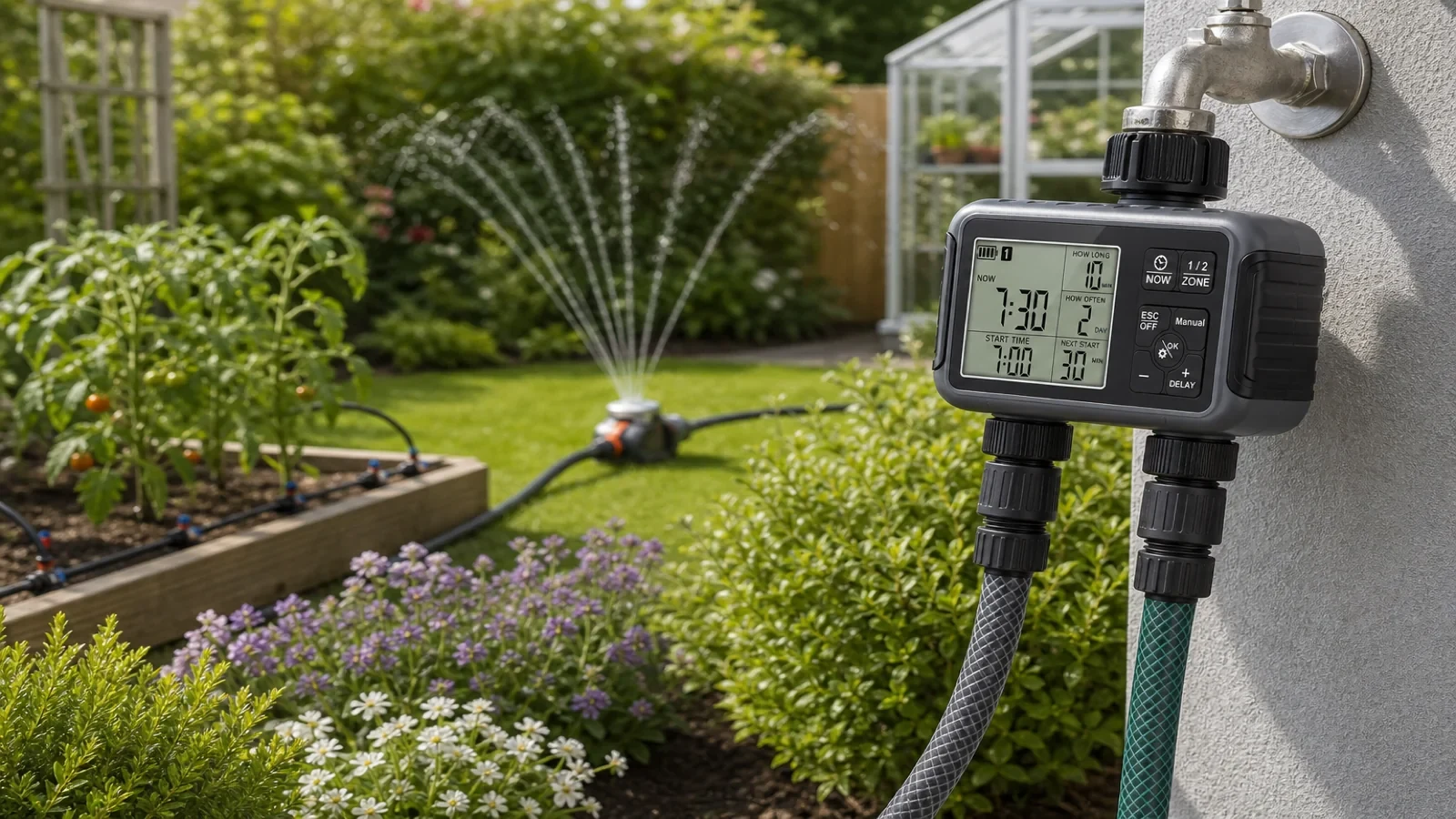
In brief: a dual zone water timer contains two controlled outlet valves fed by one tap. The useful models let you set a separate start time, run length and frequency for each valve. That independence suits mixed gardens, but both outlets still depend on the same incoming water supply.
If you are comparing specifications, separate “two outlets” from “two programmes”. A basic Y-splitter may divide the tap while leaving you to open each side manually. A true dual-zone controller automates each side and keeps its settings distinct.
How do two independent outlets work?
Water enters through one inlet and reaches two electrically controlled valves. The timer's clock and saved programme tell each valve when to open and close. Zone 1 can therefore feed a sprinkler while Zone 2 feeds a drip line, without asking both systems to use the same duration.
- The tap remains open while the timer is in service.
- The closed valves hold back the supply between programmed cycles.
- At a start time, the controller opens the selected valve.
- The valve closes after the set duration.
- A manual mode can open a valve temporarily without replacing the stored programme, if the model supports that behaviour.
This is why power condition, a correctly seated valve and accurate clock matter. A battery warning should be acted on before an unattended trip.
Single outlet, splitter or dual zone?
| Option | Automatic schedules | Best suited to | Main trade-off |
|---|---|---|---|
| Single-outlet timer | One | One circuit with similar plants | No separate routine for a second line |
| Manual Y-splitter | None by itself | Occasional hose switching | You operate both valves |
| Dual-zone timer | Two, when genuinely independent | Two circuits from one tap | Shared flow and more settings |
Decision rule: choose one controlled outlet if everything can run together. Choose two independent zones when the areas need different timings. Choose a manual splitter only if automation is not the goal.
First-time fit and buying checks are covered separately in the 2 zone water timer buyer's guide.
How should the two schedules differ?
Build a programme from the delivery method and the soil response, not from the label on the zone. A sprinkler, porous hose and point-source drippers deliver water differently. Run a supervised test, then check how far moisture has moved into the soil.
Example planning pattern
- Zone 1 — pots: short checks more often during warm, windy weather because containers can dry quickly.
- Zone 2 — established border: deeper watering only when conditions show it is needed, rather than an automatic daily splash.
The example is a planning pattern, not a prescription. Pot size, compost, shade, plant type and weather all change demand. The RHS recommends checking conditions and generally watering less often but more thoroughly for plants in the ground.
Where the controller allows overlapping start times, stagger them first. Sequential schedules make it easier to see whether each line performs properly and avoid asking both circuits to share flow.
What happens when both outlets open?
The tap does not create extra capacity because the timer has two ports. When both valves open, the available flow is divided between the connected circuits. The effect can be small for two modest drip lines or obvious where one outlet feeds a high-demand sprinkler.
A practical flow comparison
- Run Zone 1 alone and observe sprinkler reach or dripper output.
- Run Zone 2 alone and check the furthest emitter.
- If supported, run both and repeat the observations.
- If performance falls, schedule the zones at different times, shorten long pipe runs or review restrictions in connectors and filters.
Do not remove a required pressure reducer just to increase flow. Drip components may need controlled pressure, and current Temporary Use Ban conditions can require a pressure-reducing valve for a qualifying drip or trickle arrangement.
How to compare two models without being distracted
- Programme independence: verify settings for each outlet rather than counting ports.
- Allowed overlap: check whether both valves can open together and whether you need that behaviour.
- Thread and adaptors: confirm the outdoor-tap connection and both downstream connectors.
- Manual control: look for zone-specific override that preserves scheduled settings.
- Rain delay: identify whether it is a manual pause or linked to a verified sensor.
- Care requirements: read pressure, temperature, cleaning and winter-storage instructions.
A brass connection can be useful at a frequently handled joint, but material alone does not prove that the electronics, seals or valve body suit every exposure. Compare the complete specification and the support available.
Dual-zone questions
Are both outlets on a dual zone timer independent?
They should be independently programmable if the model is described as dual zone, but verify the manual or control screen. Some two-way splitters have two outlets without automatic independent valves.
Can both watering zones run at the same time?
Some models allow it and others avoid overlaps. Even when simultaneous running is supported, both lines share the tap's available flow, so test the weakest-performing combination.
Is a dual zone timer better than two single timers?
It is usually neater where only one tap is available. Two single timers can provide more physical separation but normally require two water supplies or an additional splitter and more joints.
What happens after a rain delay?
On a typical manual rain-delay function, scheduled watering pauses for the selected period and then resumes. Check the model instructions because delay choices and behaviour vary.
Ready to automate your watering with WaterTimer UK?
Upgrade Your Tap — £56.99