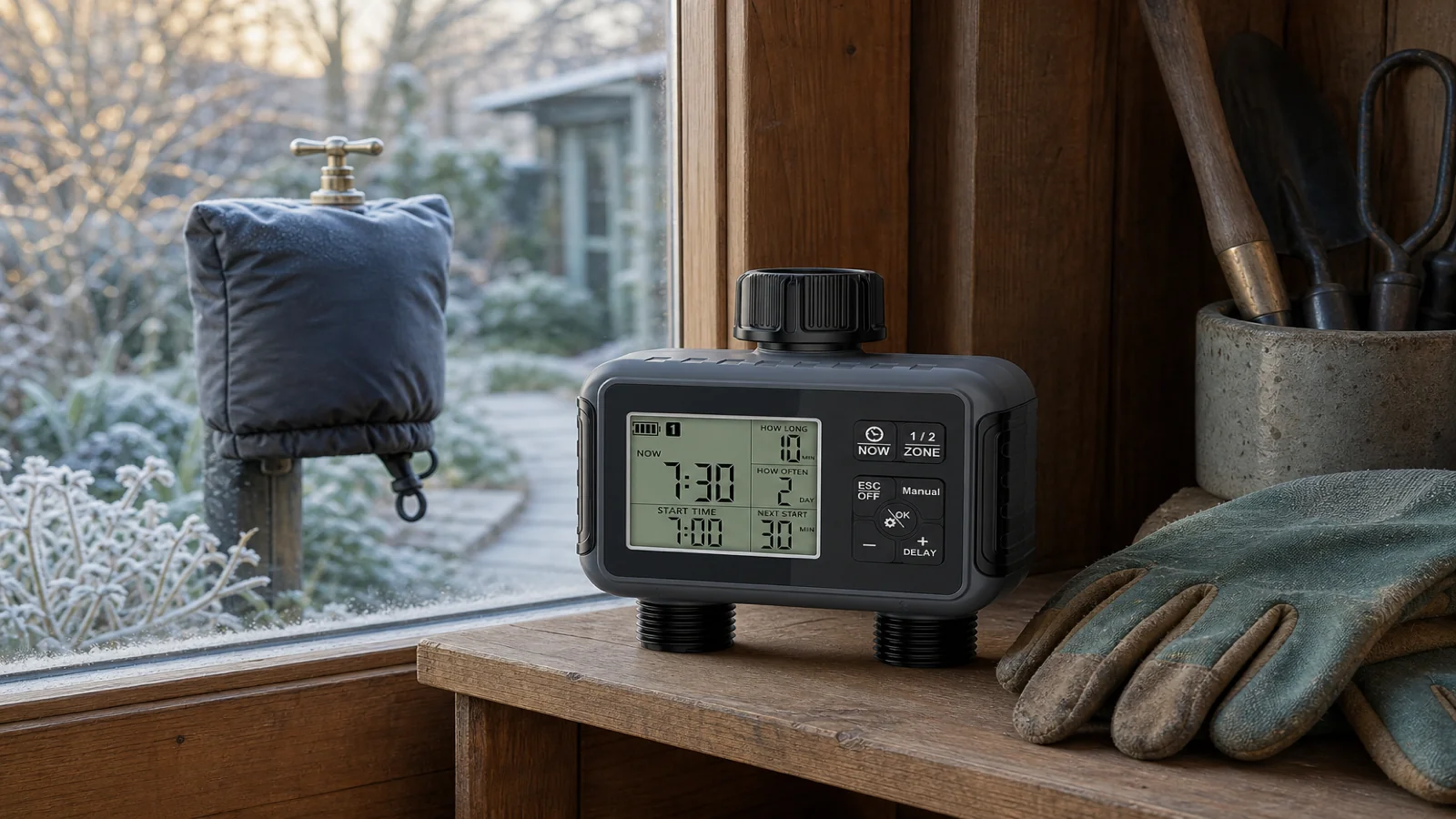
Do You Need to Take Garden Water Timers Indoors for Winter?
In UK winters, yes — plan to drain the line and bring a dual-zone digital water timer such as the SGW07M indoors (or into a frost-free place) when temperatures approach or fall below its 4.5–45°C operating range. IPX5 helps against water jets in normal outdoor use; it does not mean the timer or remaining water in fittings is safe from freezing damage.
Why cold weather and timers clash
Water expands as it freezes. Any water left in the timer body, a short connector, or a hose stub can stress plastic parts and seals. The SGW07M is a plastic-bodied timer with a BSP 3/4-inch UK thread, two independently programmable zones, and electronic scheduling on an LCD. Those parts are built for garden watering within stated limits — operating temperature 4.5–45°C and supply pressure 0.05–0.8 MPa (7.25–116 psi) — not for sitting full of water through a hard frost.
IPX5 rates protection against water jets; it is not a freeze rating. Keeping the unit outside “because it is weatherproof” confuses splash resistance with winter readiness. Treat frost as a storage and drainage problem, not an IP rating problem.
Practical winter checklist
- Stop automatic watering in good time. Clear or pause programmes on the LCD, and use rain delay (1–15 days) only when you still expect mild spells and wet soil — not as a substitute for full winterising.
- Close the outdoor tap at the house side so no fresh water feeds the timer.
- Open the timer outlets and any downstream valves briefly to relieve pressure, then disconnect hoses from both zones.
- Remove the timer from the BSP 3/4-inch tap thread. Tip and drain residual water from the inlets and outlets.
- Take batteries out for long storage. The unit uses 2×AA alkaline batteries (not included); rechargeable batteries are not recommended in normal use, and leaving any cells in over winter risks leakage onto contacts.
- Store indoors somewhere dry and above the lower end of the operating mindset — a shed that still drops below 4.5°C is a weak choice if the timer retains moisture.
- Cap or cover the outdoor tap if you use an insulated tap jacket, and drain exposed pipework according to how your outdoor supply is plumbed.
- Note spring restart limits: refit only when temperatures are comfortably within 4.5–45°C, fit fresh alkaline AAs, reopen the tap for scheduled use, and re-enter durations (1–360 minutes) and frequencies (every 1–23 hours or every 1–15 days) for each zone.
What you can leave connected — and what you should not
Underground or well-drained irrigation laterals may have their own winter routine, but the tap-mounted timer is the vulnerable “above ground brain.” Do not leave a dual-zone timer such as the SGW07M screwed to an exposed outdoor tap through freezing nights while still wet inside. Do not rely on manual mode, child lock, or the LCD as winter features — they help daily control in the growing season, not frost survival.
If a mild winter week appears and you briefly water a greenhouse or raised bed, treat it as a temporary install: fit the timer, run a short programme within the allowed duration range, then drain and remove again before the next cold snap. That is more work than a set-and-forget summer schedule, but it respects the temperature window.
Pressure and system type before you pack away
While winterising, glance at the rest of the setup you used in summer. The same dual-zone outlet that fed sprinklers on a lawn or drip lines in flower beds and raised beds should be empty and disconnected. Greenhouses often invite “just one more week” of watering; if the header freezes, the timer is still at risk if left charged with water. Stay within 0.05–0.8 MPa when the system is live in milder months; winter storage is about emptiness and warmth, not pressure tricks.
Boundaries of this advice
This checklist applies to tap-mounted electronic timers used on lawns, flower beds, raised beds, greenhouses, sprinklers, and drip irrigation in typical UK gardens. It does not claim a measured freeze-test result beyond the published 4.5–45°C operating range. It does not cover heated outdoor taps, buried valves, or professional backflow assemblies. There is no app, Wi‑Fi, or Bluetooth on the SGW07M, so winterising is entirely a hands-on outdoor job — which is also why nothing in the cloud can remind you to bring the unit in.
FAQ
Is IPX5 enough to leave it out?
No. IPX5 addresses water jets, not ice expansion inside the valve body.
Can I leave programmes saved over winter?
You can note your durations and frequencies on paper before storage; remove batteries for long idle periods and expect to recheck settings in spring.
When is it safe to refit?
When outdoor conditions sit within 4.5–45°C, the tap and timer are drained of ice risk, and you are ready to leave the tap open again for automatic dual-zone runs.
Looking for a dual-zone digital water timer such as the SGW07M to programme locally for the growing season — then store properly for winter — see the dual-zone digital water timer on watertimer.co.uk.
Ready to automate your watering with WaterTimer UK?
Upgrade Your Tap — £56.99