What Happens If a Smart Watering App Shuts Down?
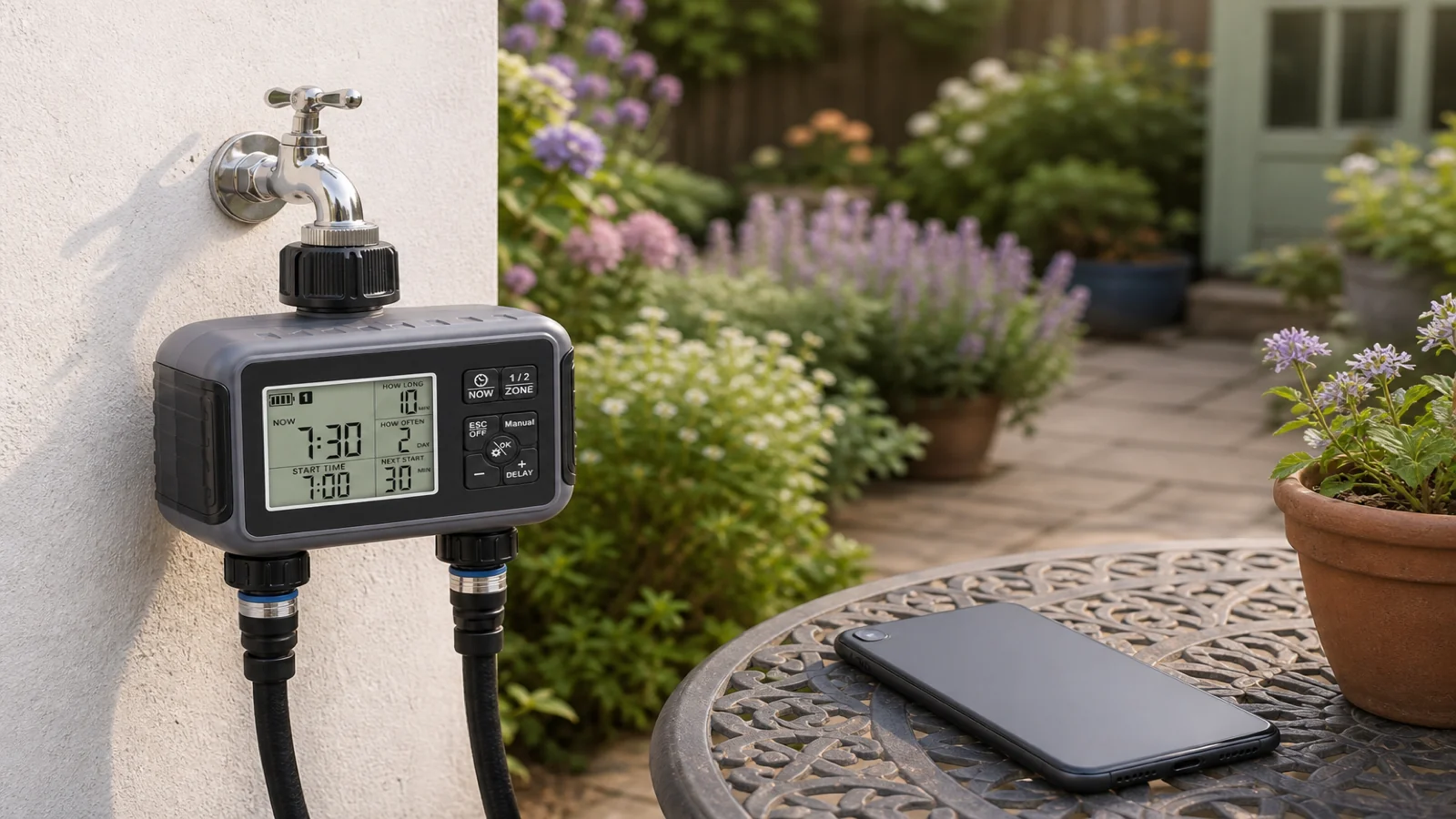
If a watering app or cloud service stops, phone-dependent schedules can stop with it — or become awkward to change. A dual-zone digital water timer such as the SGW07M avoids that risk by keeping programmes on the device itself: no app, no Wi‑Fi, and no Bluetooth. You set times on the LCD; the valves follow those settings whether or not a company still exists behind a login screen.
App-linked watering versus on-device programming
Smart watering usually pairs hardware with an account, firmware updates, and a mobile app. That can feel convenient until the account needs a new password, the phone OS drops an older app, the manufacturer winds down the product line, or the cloud endpoint is retired. None of those events empty your outdoor tap, but they can leave you without an easy way to edit schedules you once controlled from a sofa.
By contrast, a no-app dual-zone timer keeps the “brain” at the tap. On a unit such as the SGW07M you programme two independent zones with:
- watering durations from 1 to 360 minutes;
- repeat cycles every 1–23 hours or every 1–15 days;
- rain delay for 1–15 days;
- manual mode for immediate runs;
- child lock to reduce accidental changes;
- an LCD for local readout.
Those controls do not call home. When the batteries are healthy and the tap is open, the schedule continues regardless of app store policies or server status.
What “company shutdown” anxiety really covers
Gardeners who ask about apps shutting down are usually worried about three practical outcomes: losing the ability to change watering times, losing remote start/stop, and being pushed into a replacement product earlier than planned. On-device programming answers the first concern directly — you still change duration and frequency at the timer. Remote start/stop was never part of a no-app design, so there is nothing to lose on that axis. Replacement pressure is lower when the timer’s usefulness does not depend on a living subscription or cloud feature set.
A plastic-bodied, IPX5-rated dual-zone timer with a BSP 3/4-inch UK thread is still a piece of outdoor hardware. It needs correct pressure (0.05–0.8 MPa / 7.25–116 psi), temperatures within 4.5–45°C, and two AA alkaline batteries (not included; rechargeables are not recommended). Those are physical constraints, not software ones — and they are easier for most households to check than the health of a vendor’s backend.
Side-by-side: what you gain and what you trade
On-device dual-zone digital timer (e.g. SGW07M)
- Schedules stored locally; no account required.
- Two independently programmable outlets for lawns, beds, raised beds, greenhouses, sprinklers, or drip lines.
- Rain delay and manual mode without opening a phone.
- No Wi‑Fi setup, no Bluetooth pairing, no app updates.
- Trade-off: you walk to the tap (or greenhouse header) to edit programmes; there is no remote notification if a run fails.
App-dependent smart watering
- Remote edits and alerts can be convenient while the service runs well.
- Trade-off: schedule control may hinge on app availability, account access, and ongoing vendor support.
- A shutdown or forced migration can turn a “set from anywhere” tool into a fixed or opaque device overnight.
Neither approach removes the need for sound plumbing. Both still rely on an open outdoor tap during automatic runs, sound joints on a BSP 3/4-inch UK thread, and watering lengths that suit the plants rather than the maximum the dial allows.
When a no-app timer is the calmer UK choice
Choose local programming if you want irrigation that keeps working through phone upgrades, holiday travel without relying on home Wi‑Fi, shared gardens where not everyone should have an account, or simply a preference for hardware you can read on an LCD. Dual-zone independence helps when a lawn and a drip-fed raised bed need different frequencies within the same 1–23 hour or 1–15 day options.
Stay cautious if your plot genuinely needs phone control from off-site every week, if you refuse any walk-up programming, or if your supply sits outside the stated pressure or temperature range. A no-app timer is not “smarter” in the marketing sense; it is more self-contained.
Boundaries worth stating clearly
This comparison is about control location, not about invented savings figures. The SGW07M does not claim app features it does not have. It is suited to lawns, flower beds, raised beds, greenhouses, sprinkler, and drip use within its pressure and temperature limits. It will not replace a full irrigation controller for complex multi-station systems beyond two outlets, and it will not phone you if someone closes the outdoor tap.
FAQ
If there is no app, how do I pause after rain?
Use the rain delay for 1–15 days on the timer, or switch to manual oversight until you resume the usual frequency.
Can two zones still differ without software?
Yes. Independent programming on each outlet is handled on the device, within the shared duration and frequency ranges.
What happens when batteries die?
Replace with two AA alkaline cells. Without power the electronic schedule cannot run; that is a battery issue, not an app-cloud issue.
For a dual-zone digital water timer such as the SGW07M that programmes on the unit without an app, visit the dual-zone digital water timer product page on watertimer.co.uk.
Ready to automate your watering with WaterTimer UK?
Upgrade Your Tap — £56.99