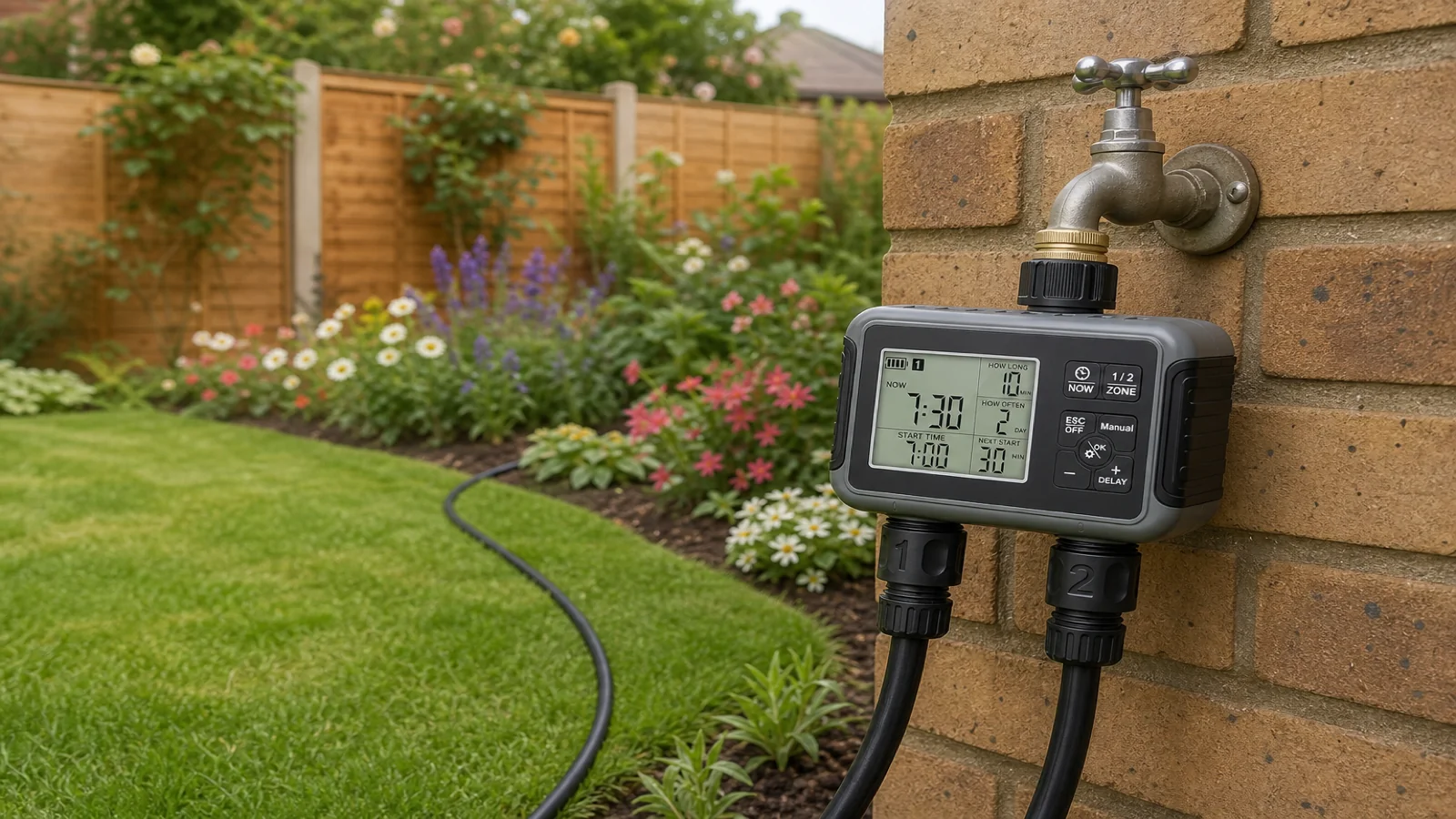
Do You Need to Leave Your Outdoor Tap On with a Water Timer?
Yes — for a dual-zone digital water timer such as the SGW07M to water on schedule, the outdoor tap must stay open while the timer is in use. The timer sits between the tap and your irrigation lines and opens or closes its own valves according to the programmes you set. Leaving the tap on does not mean water runs all the time, and it does not mean your bill will climb every hour the tap remains open.
How the tap and the timer share the job
Think of the outdoor tap as the supply gate and the timer as the automatic shut-off. Water can only leave the system when both are open. With the tap open and the timer closed between cycles, the hose or drip line stays dry. When a programmed zone starts, the timer opens that outlet for the duration you chose, then shuts it again. The tap simply keeps pressure available at the timer inlet.
A dual-zone model such as the SGW07M uses a BSP 3/4-inch UK thread at the tap connection and offers two independently programmable outlets. That means each zone can run to its own schedule while still drawing from the same open tap. You are not choosing between “tap on forever” and “tap off forever”; you are choosing when each outlet is allowed to pass water.
Will water keep flowing if the tap stays open?
Not if the timer is working as intended and your programmes are clear. Between watering windows both outlets should remain closed, so an open tap alone does not create a continuous stream through the garden. Water flows only while a zone is in an active run, in manual mode if you start a cycle by hand, or if something physical is wrong — for example a hose left open downstream of an outlet that has been left in a run state.
Useful controls on a unit like the SGW07M include:
- run times from 1 to 360 minutes per watering;
- repeat frequencies every 1–23 hours or every 1–15 days;
- a rain delay of 1–15 days when you want to pause automatic schedules after wet weather;
- manual mode for a one-off soak without rewriting the weekly pattern;
- a child lock and LCD so settings are readable and harder to nudge by accident.
Those features are there so the open tap is not an open invitation to endless watering. You decide how long each zone runs and how often it returns.
Does leaving the tap on raise the water bill?
Your usage (and therefore the metered part of the bill) tracks water that actually leaves the pipe. An open tap feeding a closed timer valve should not register as continuous consumption. Bills rise when watering runs are long, frequent, overlapping across both zones, or left on in manual mode without a clear end. They also rise if a fitting leaks at the thread, a washer fails, or a drip line has an open end downstream of an open outlet.
Practical ways to keep usage intentional:
- match duration to the bed or lawn, within the 1–360 minute range;
- choose hourly or daily frequency that suits soil and season, not the maximum available;
- use rain delay for 1–15 days after heavy rain instead of deleting programmes;
- check BSP joints and hose connectors after fitting so drips do not become a quiet background cost;
- confirm both zones are closed on the LCD when you expect the garden to be dry.
The timer does not invent water use; it meters opportunity. Short, planned runs on two zones still use less than leaving a hose unattended at the tap.
Pressure, temperature, and power in everyday UK use
The SGW07M is specified for operating pressure of 0.05–0.8 MPa (7.25–116 psi) and an operating temperature range of 4.5–45°C. Stay inside those limits for reliable valve behaviour. It is a plastic-bodied, IPX5-rated unit powered by two AA alkaline batteries (not included); rechargeable batteries are not recommended. There is no app, Wi‑Fi, or Bluetooth — schedules live on the device, which suits gardeners who want the tap-and-timer relationship to stay local and predictable.
Where this approach fits — and where it does not
Leaving the tap open behind a programmed dual-zone timer suits lawns, flower beds, raised beds, greenhouses, sprinkler setups, and drip irrigation when you want automatic watering without standing by the tap. It is a poor fit if you need the outdoor tap for other jobs at the same time and cannot share the outlet; if supply pressure sits outside 0.05–0.8 MPa; if you expect remote phone control; or if you plan to leave the timer fitted when temperatures fall below the 4.5°C operating range. In shared outdoor taps, a clear “timer in use — leave open” note for household members avoids someone shutting the supply mid-cycle.
FAQ
Can I close the tap between waterings?
You can, but then automatic programmes will not run until the tap is open again. For unattended schedules, leave the tap open and let the timer close the outlets.
What if both zones are programmed?
Each outlet is independently programmable. Check the LCD so overlapping runs are intentional, not accidental double demand on a small bed.
Does IPX5 mean I can ignore leaks?
No. IPX5 relates to water resistance of the unit; it does not replace sound hose joints or a dry path between cycles.
If you want a dual-zone digital water timer such as the SGW07M with local LCD programming and no app dependency, see the dual-zone digital water timer on watertimer.co.uk.
Ready to automate your watering with WaterTimer UK?
Upgrade Your Tap — £56.99