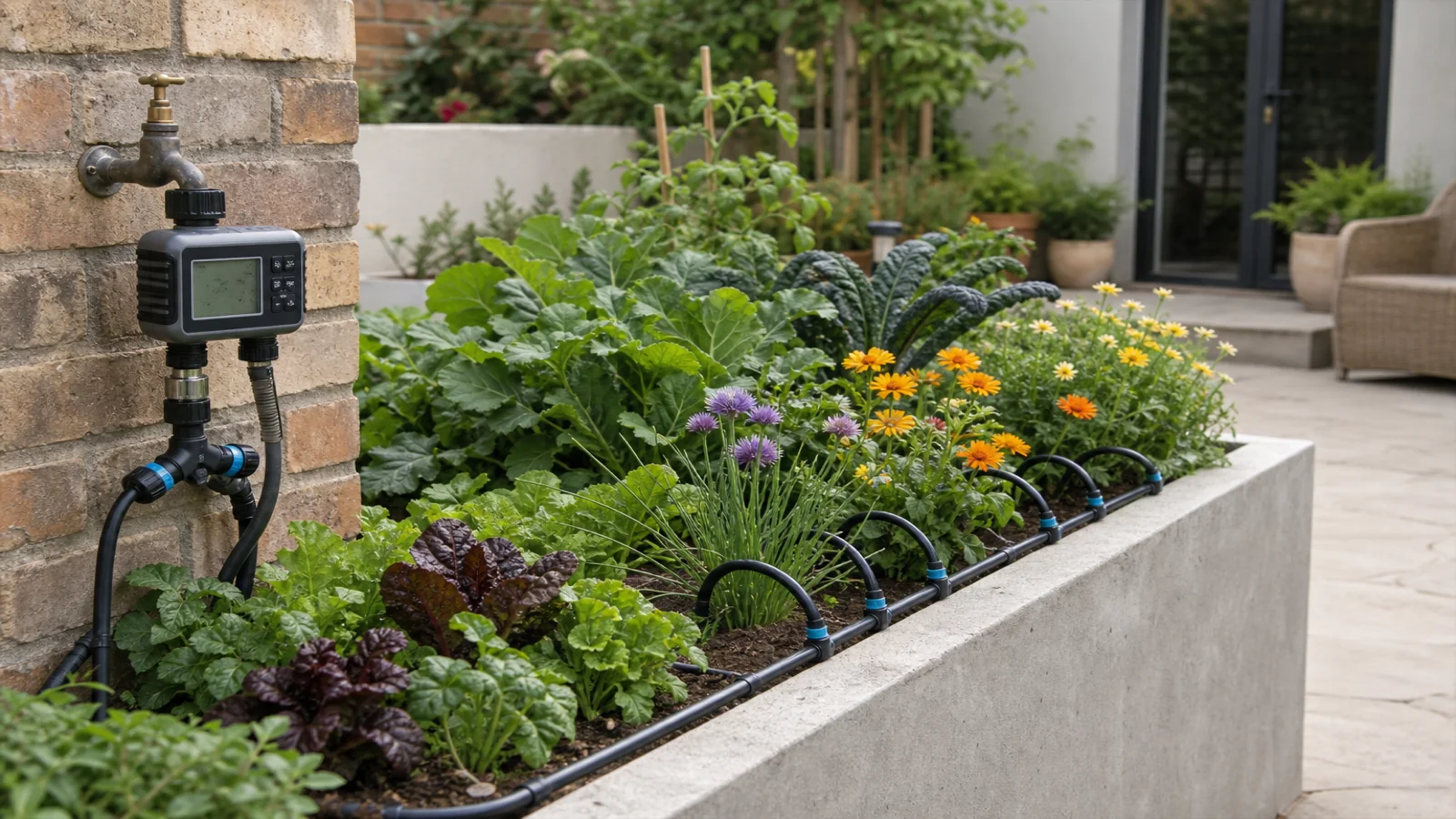
Can You Water a Cement Raised Bed with a Tap Timer?
Yes—provided the timer is fitted to your outdoor tap, not built into the cement bed. Run hose or drip from the tap timer to emitters in the bed. A dual-zone digital water timer such as the SGW07M can serve a cement raised bed on one outlet and another bed, lawn edge, or greenhouse line on the second.
Clarify where the timer lives
Cement and masonry raised beds confuse many first-time installers. The bed holds soil and plants; the timer belongs on the UK outdoor tap (commonly BSP 3/4"). Water then travels through hose, manifold, or drip tubing into the bed. Nothing about a tap timer requires embedding electronics in concrete. Keeping the unit at the tap also means you can use the LCD, child lock, and manual override without kneeling in the bed.
Plastic-bodied timers designed for outdoor taps—such as the SGW07M—are IPX5 rated for water resistance and intended for garden use within 0.05–0.8 MPa and 4.5–45°C. Power comes from 2×AA alkaline batteries (not included; rechargeable batteries are not recommended). There is no app.
How cement beds change watering behaviour
Cement raised beds often warm and dry faster than in-ground borders, especially on sunny walls or paved courtyards. Soil volume is limited; drainage depends on how the bed was built. That usually means checking moisture more often at first, then setting a schedule that suits the mix—not copying a lawn programme.
Drip irrigation along plant rows is a practical match: slow delivery reduces splash on cement faces and helps water reach roots rather than running off hard surfaces. Sprinkler heads can work for densely planted beds, but watch for overspray onto paths. The timer does not choose the method; you do. The timer only opens and closes outlets on time.
A practical schedule model for one or two beds
Use this as a starting framework and adjust after watching the soil for a week.
- Zone 1 – cement raised bed on drip: duration often in the 20–60 minute range (within the 1–360 minute capability), frequency every 1–3 days in mild weather, tighter in heat. Prefer 1–23 hour cycles only when pots or very shallow mixes dry within a day.
- Zone 2 – second bed, border, or greenhouse line: set its own duration and frequency. Independent outlets mean you are not forced into one compromise time for dissimilar plantings.
- Rain delay: when UK showers soak the bed, pause watering for 1–15 days instead of stacking irrigation on wet soil.
- Manual: use manual mode after planting or fertilising when you want a one-off soak without rewriting the schedule.
Always confirm each outlet with a short manual test after installation. Check joints for drips where hose meets the timer and where drip tape enters the cement bed.
Installation outline (tap first, bed second)
- Confirm BSP 3/4" outdoor tap and clear access for a hanging timer.
- Install drip or hose layout inside the cement raised bed; flush the line before connecting.
- Fit a dual-zone digital water timer such as the SGW07M to the tap; insert 2×AA alkaline batteries.
- Connect outlet one to the raised-bed line; use outlet two for a second circuit if needed.
- Programme duration (1–360 min) and frequency (1–23 h or 1–15 days) on the LCD; enable child lock once settings are confirmed.
- After rain, set rain delay 1–15 days; clear it when the soil surface has dried appropriately for your plants.
Boundaries
- The timer does not mount in or through cement; it remains on the tap.
- No adjustable flow control, flow meter, or litre display is claimed—manage emitter choice and run time yourself.
- No filtration or anti-clog feature is claimed; debris in new hose or hard water deposits are your maintenance task.
- Not an app-controlled system—programming is on-device.
- Suitable contexts include lawns, flower beds, raised beds, greenhouses, sprinkler systems, and drip irrigation within the stated pressure and temperature ranges.
FAQ
Will cement damage the timer?
The timer should not sit in the bed. Keep it on the tap. The bed only receives water via hose or drip.
Can two cement beds share one timer?
Yes, using two independent outlets with separate durations and frequencies if the plants differ.
What if a storm soaks the bed?
Use rain delay for 1–15 days so automatic cycles do not restart while the soil is already wet.
See the SGW07M dual-zone tap timer for cement raised beds watered from the outdoor tap—not from the bed wall.
Ready to automate your watering with WaterTimer UK?
Upgrade Your Tap — £56.99